
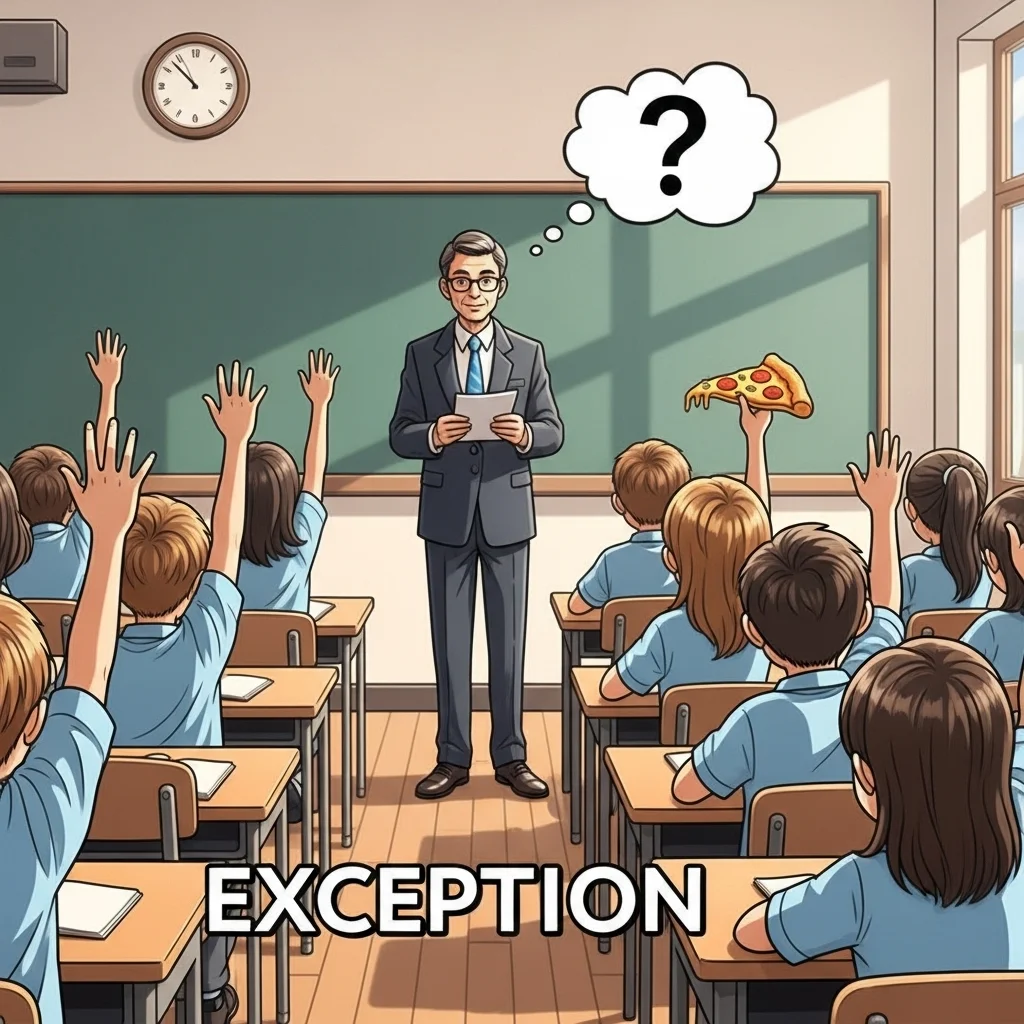

What Does Exception Meaning?
An exception is something that differs from the usual or expected rule. It highlights a case that is special, unusual, or excluded from a general statement.
Exception Meaning in Daily Life
In everyday conversation, an exception often refers to someone or something that doesn’t follow the normal rules. For example:
-
“Everyone must wear a uniform, but John is an exception.”
Here, John is not following the rule that applies to everyone else.
Exception Meaning in Rules and Laws
Legal or formal rules often use the term exception to indicate cases that are exempt. For instance:
-
“All employees must report overtime, with exceptions for interns.”
This means interns are not required to follow the rule.
Exception in Programming
In computer programming, an exception refers to an unexpected event that interrupts the normal flow of a program. For example, dividing a number by zero may raise an exception, signaling an error that needs to be handled.
Exception Meaning in Logic
In logical statements, an exception is a case where a general rule does not apply. For example:
-
Rule: “Birds can fly.”
-
Exception: “Penguins cannot fly.”
Common Misunderstandings About Exception
-
Exception ≠ Error (always): In daily language, an exception can simply be a special case, not necessarily a mistake.
-
Not all exceptions are negative: Some exceptions are neutral or even positive, such as a bonus rule in a game.
Synonyms for Exception
Common synonyms include:
-
Exclusion
-
Anomaly
-
Irregularity
-
Special case
Antonyms for Exception
Words that convey the opposite of exception include:
-
Rule
-
Standard
-
Norm
-
Regularity
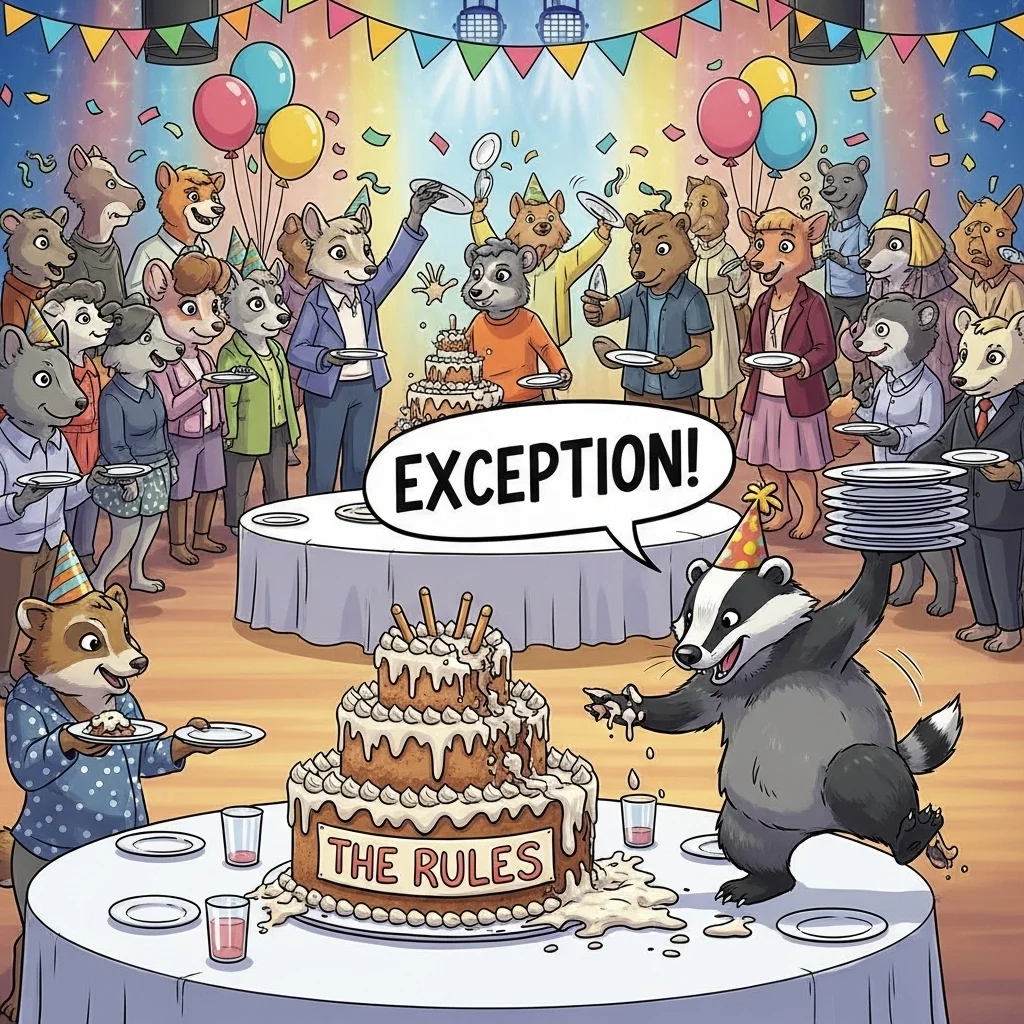
Exception in Education
Teachers often allow exceptions for rules. For example, a student may get an extension for homework due to illness—this is an exception to the normal rule.
Exception in Finance
Financial rules can have exceptions, such as tax exemptions or special cases for deductions.
Exception in Healthcare
Doctors may make exceptions to treatment guidelines based on a patient’s unique needs, showing flexibility in applying general rules.
Exception in Sports
Sports rules sometimes allow exceptions, like a referee making a special call for unusual circumstances during a game.
Exception in Contracts
Contracts often include exception clauses to protect parties in special circumstances. For example, a contract might include:
-
“All deliveries must be on time, except in cases of natural disasters.”
Exception in Science
In scientific observations, exceptions refer to phenomena that do not fit established theories or patterns, prompting further study.
Exception in Religion
Religious rules or rituals sometimes allow exceptions for special circumstances, showing flexibility and understanding.
How to Use Exception Correctly
-
Use exception to highlight unusual or special cases.
-
Avoid using it for ordinary situations—reserve it for cases that truly differ from the norm.
-
Remember: exceptions are not always mistakes or problems.
Modern Usage of Exception
In modern English, exception is used in conversations, emails, social media, and professional communication to point out unique cases or special rules.

Exception vs. Exemption
-
Exception: A case that does not follow the rule.
-
Exemption: Being officially excused from following a rule.
Example: “All students must attend class, with exceptions for online learners.”